
Why Law Firms Are Prime Targets for Cyber Attacks
Law Firm Cybersecurity Guide
Law firms are no longer an overlooked corner of the cyber threat landscape. In fact, they have become one of the most attractive targets for cybercriminals. From ransomware gangs to phishing operators, attackers actively pursue law firms of all sizes—because the payoff is high and the defenses are often weaker than expected.
This guide explains why law firms are prime targets for cyber attacks, the most common threats facing the legal industry, and how law firms can reduce cyber risk before an incident occurs.
What Makes Law Firms Prime Targets for Cyber Attacks?
Law firms are prime targets for cyber attacks because they store highly sensitive client data, manage financial transactions, operate under strict deadlines, and often lack enterprise-level cybersecurity controls. Cybercriminals exploit these conditions to launch ransomware, phishing, and business email compromise attacks.
This combination of valuable data + urgency + trust makes law firms uniquely vulnerable.
Why Do Hackers Target Law Firms?
Hackers target law firms because they combine high-value information with lower cybersecurity maturity compared to large enterprises.
Key reasons hackers target law firms:
- Access to confidential and privileged client data
- Financial transactions, wire transfers, settlements, and escrow accounts
- Attorney–client privilege limiting external scrutiny
- High pressure to restore operations quickly during incidents
Sensitive Client Data Makes Law Firms High-Value Targets
Law firms routinely store and manage:
- Attorney–client privileged communications
- Mergers and acquisitions data
- Intellectual property and trade secrets
- Litigation strategies and evidence
- Personally Identifiable Information (PII)
- Medical records in personal injury and healthcare cases
This data is more valuable than credit card numbers. It can be used for extortion, insider trading, fraud, or resale on the dark web. A single breach can expose hundreds of clients simultaneously—creating serious legal, financial, and reputational consequences.
Attorney–Client Privilege Creates Hidden Cyber Risk
Attorney–client privilege is essential—but it can also create blind spots. Clients often share information with their attorneys that they do not share anywhere else. At the same time, many law firms rely on confidentiality agreements instead of modern cybersecurity controls, assuming trust alone is enough.
Cybercriminals understand this imbalance and exploit it. Law firms frequently inherit risk from their clients without inheriting the same cybersecurity budgets, tooling, or security teams that enterprise organizations have in place.
What Types of Cyber Attacks Affect Law Firms Most?
The most common cyber attacks against law firms include:
- Ransomware attacks that encrypt case files and lock systems
- Business Email Compromise (BEC) targeting wire transfers and settlement payments
- Phishing attacks aimed at stealing credentials and gaining access
- Unauthorized access to email, file shares, or document management systems
These threats are often quiet, fast-moving, and financially devastating—especially when client trust is on the line.
Why Is Ransomware Especially Dangerous for Law Firms?
Ransomware is especially dangerous for law firms because downtime can halt court filings, disrupt deadlines, and expose confidential client data.
A ransomware event can lock:
- Case management systems
- Discovery files and evidence repositories
- Document management platforms
- Shared drives and email archives
Missed deadlines, locked evidence, and leaked communications can lead to:
- Malpractice exposure
- Ethical violations
- Loss of client trust
- Reputational damage
For attackers, law firms are ideal victims because time pressure increases the likelihood of payment.
Business Email Compromise in the Legal Industry
Law firms routinely manage high-value financial transactions, making them prime targets for Business Email Compromise (BEC) scams. These attacks often involve social engineering rather than malware, which makes them harder to detect with basic security tools.
Common BEC scenarios include:
- Fake emails requesting last-minute wiring changes
- Compromised attorney inboxes sending fraudulent instructions
- Spoofed emails impersonating partners, clients, or vendors
Because BEC attacks can look legitimate, they can lead to significant losses before a firm realizes anything is wrong.
Are Small Law Firms at Risk of Cyber Attacks?
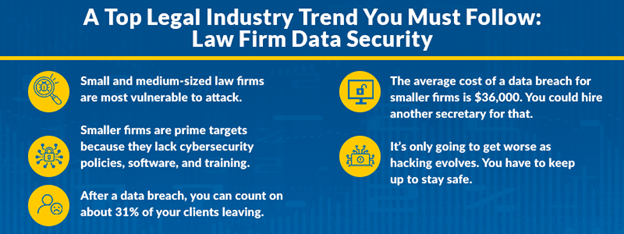
Yes, small and mid-sized law firms are frequently targeted by cybercriminals. Attackers prefer smaller firms because they often have fewer security resources and limited detection capabilities—while still maintaining access to valuable client information.
Firm size does not reduce risk. In many cases, it increases it.
Remote Work Expanded the Law Firm Attack Surface
Remote and hybrid work have introduced new security risks for law firms, including:
- Personal devices accessing firm systems
- Home networks without enterprise-grade security
- Cloud platforms configured for convenience rather than control
- Remote access tools lacking strong identity and monitoring
Without proper endpoint security, identity protection, and logging, these environments can become easy entry points for attackers.
What Cybersecurity Risks Are Unique to Law Firms?
Unique cybersecurity risks for law firms include attorney–client privilege exposure, escrow fraud, regulatory obligations, and ethical responsibilities tied to client confidentiality.
Unlike many industries, a single breach at a law firm may affect multiple clients, active litigation, and sensitive negotiations at once. This amplifies legal and reputational consequences and can trigger contract penalties and regulatory scrutiny.
Regulatory and Ethical Consequences of Cyber Attacks on Law Firms
Cyber incidents don’t just cause downtime—they create professional and legal exposure. Depending on your jurisdiction and practice areas, a breach can trigger:
- State bar investigations
- Breach notification requirements
- Client lawsuits
- Contractual penalties
- Loss of professional reputation
Many bar associations now explicitly state that attorneys have a duty to understand and manage cybersecurity risks related to client data.
What Cybersecurity Protections Should Law Firms Have?
Law firms should implement the following cybersecurity protections:
- 24/7 security monitoring and threat detection
- Email security and anti-phishing controls
- Multi-factor authentication (MFA) across systems
- Secure backups and disaster recovery
- Regular vulnerability management and patching
- Incident response planning and testing
- Employee security awareness training
Modern law firm cybersecurity requires a layered, proactive approach—not just reactive IT support.
Common Cyber Risks Facing Law Firms
| Cyber Risk | Impact on Law Firms |
|---|---|
| Ransomware | Missed deadlines, data exposure |
| Phishing | Credential theft, account compromise |
| Business Email Compromise | Wire fraud and financial loss |
| Unpatched systems | Unauthorized access |
| Weak passwords | System takeover |
How Can Law Firms Reduce Cyber Attack Risk?
Law firms can reduce cyber attack risk by partnering with a managed IT and cybersecurity provider experienced in the legal industry, implementing layered security controls, and conducting regular risk assessments.
Cybersecurity should be treated as a business risk management function, not just an IT expense.
Cybersecurity Is Now a Client Expectation
Corporate clients and insurers increasingly require law firms to:
- Complete cybersecurity questionnaires
- Pass security audits
- Demonstrate formal security controls
Firms that cannot meet these expectations risk losing clients—not because of legal skill, but because of cyber risk exposure.
Quick Summary: Law Firm Cybersecurity Risks
Law firms are prime cyber attack targets due to sensitive data, financial transactions, strict deadlines, and limited security controls. Ransomware, phishing, and email fraud pose the greatest threats, especially for small and mid-sized firms.
Final Thoughts: Law Firms Are Targets—Prepared or Not
Law firms are prime cyber attack targets due to sensitive data, financial transactions, strict deadlines, and limited security controls.
The question is no longer if a law firm will be targeted, but how prepared it will be when it happens.
Ready to Strengthen Your Law Firm’s Cybersecurity?
A proactive cybersecurity assessment can identify gaps before attackers do—and help protect your clients, your reputation, and your practice.
Next step: contact us, for a limited time to request a Free Law Firm Cyber Risk Assessment.