
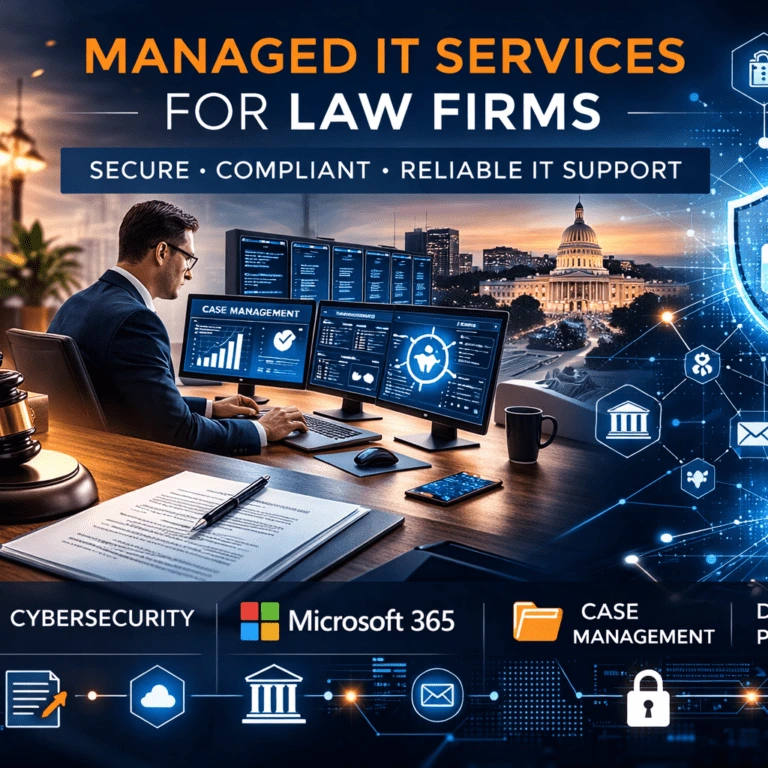
The Ultimate Guide to Managed IT Services for Law Firms
Law firms operate in one of the most confidential, deadline-driven, and risk-sensitive environments in business. Every email, document, deposition transcript, financial record, intellectual property file, medical record, and litigation strategy memo represents protected information.
For law firms in Northern Virginia, especially those serving federal contractors, government agencies, healthcare providers, and defense-sector organizations, the cybersecurity expectations are even higher.
Modern managed IT services for law firms must go beyond fixing computers. They must secure legal software platforms, enforce ethical confidentiality obligations, prevent ransomware, protect trust accounts, enable secure remote work, and ensure uptime during critical court deadlines.
This pillar guide explains what law firms need to know about IT support, cybersecurity protection, compliance alignment, and legal technology management.
Table of Contents
- Why Law Firms Are High-Value Cyber Targets
- Law Firm Technology Stack: What Must Be Protected
- What Managed IT Services for Law Firms Should Include
- Ransomware Protection for Law Firms
- Microsoft 365 Security for Law Firms
- Email Security and Business Email Compromise Prevention
- Secure Remote Work for Attorneys
- Compliance and Ethical Responsibilities of Law Firms
- IT Planning for Growing Law Firms
- Litigation Readiness and Technology Stability
- Local IT Support for Law Firms in Northern Virginia
- The Business Case for Managed IT Services
- FAQs: IT Services for Law Firms
- Conclusion
Why Law Firms Are High-Value Cyber Targets
Cybercriminals target law firms because they store concentrated, high-value data including personally identifiable information, financial and banking records, intellectual property, mergers and acquisition documents, litigation strategy, healthcare data, and government contract documentation.
Unlike large enterprises, many small and mid-sized law firms lack internal security teams. Attackers view them as high-value but under-defended. Legal deadlines also create pressure. During active litigation, firms may feel forced to pay ransomware demands quickly to restore access to case files.
The cost of a breach can include operational downtime, client loss, reputational damage, bar complaint exposure, incident response expenses, and potential regulatory penalties. Legal IT must be built around risk reduction.
Law Firm Technology Stack: What Must Be Protected
A modern law firm operates on specialized platforms. IT providers must understand and support the legal technology ecosystem.
Case Management Systems
- Clio
- MyCase
- PracticePanther
- ProLaw
- Needles
These systems contain client records, deadlines, billing entries, and internal notes. Compromise could expose entire caseloads. Security requirements include role-based permissions, multi-factor authentication, secure integrations, audit logging, and encrypted connections.
Document Management Systems
- iManage
- NetDocuments
- Worldox
These platforms house contracts, pleadings, discovery, and privileged communications. IT providers should ensure secure storage architecture, backup validation, access restrictions, data loss prevention, and secure remote access controls.
Legal Research Platforms
- Westlaw
- LexisNexis
- Bloomberg Law
While typically cloud-hosted, account compromise can expose research strategy and client intent. Credential protection is critical.
Time, Billing, and Trust Accounting Software
- Tabs3
- PCLaw
- TimeSolv
- CosmoLex
- QuickBooks trust accounting configurations
Trust account fraud is one of the most damaging cybersecurity events for a law firm. Business email compromise can redirect wire transfers or manipulate invoice payments. Security should include multi-factor authentication, transaction monitoring, strict access control, email spoofing protection, and wire verification procedures.
eDiscovery and Litigation Platforms
- Relativity
- Everlaw
- Logikcull
These platforms contain sensitive discovery materials, often including confidential corporate or medical records. Access control, logging, and secure storage configuration are mandatory.
What Managed IT Services for Law Firms Should Include
A true managed IT program for legal practices should include proactive monitoring, advanced endpoint protection, Microsoft 365 administration, email threat filtering, access control enforcement, firewall management, secure WiFi configuration, encrypted backups, mobile device management, and secure remote access.
- 24/7 proactive monitoring and alerting
- Advanced endpoint detection and response
- Microsoft 365 administration
- Exchange Online protection
- Email threat filtering
- Conditional access policies
- Firewall management
- Secure WiFi configuration
- Encrypted backup and disaster recovery
- Mobile device management
- Secure VPN or zero-trust remote access
- Quarterly technology planning reviews
- Vendor coordination with legal software providers
Featured Snippet: What IT Services Do Law Firms Need?
Law firms need proactive IT monitoring, secure Microsoft 365 management, advanced cybersecurity protection, encrypted backups, firewall management, secure access controls for legal software, and compliance alignment with professional confidentiality requirements.
Ransomware Protection for Law Firms
Ransomware remains the most disruptive threat to legal practices. It typically targets shared drives, document management systems, case data, and backup repositories.
Effective ransomware defense includes layered endpoint protection, behavior-based detection, network segmentation, patch management, immutable backups, routine backup testing, and documented incident response plans.
Backup without testing is a false sense of security. Recovery capability should be validated regularly.
Microsoft 365 Security for Law Firms
Most law firms operate on Microsoft 365. However, default configurations are rarely sufficient for legal-grade security. Proper hardening reduces breach risk significantly.
- Multi-factor authentication for all users
- Conditional access policies
- Geolocation restrictions
- Data loss prevention policies
- Encrypted email enforcement
- Advanced threat protection
- Admin role restrictions
- Audit logging
Email Security and Business Email Compromise Prevention
Email is the primary attack vector for law firms. Attackers use spoofed client emails, fake wire instructions, credential harvesting links, and malicious document attachments.
Protection should include DMARC, SPF, and DKIM configuration, phishing filtering, MFA enforcement, user security awareness training, external sender warnings, and wire verification protocols.
Trust account fraud often begins with a compromised email account.
Secure Remote Work for Attorneys
Attorneys frequently access systems from home offices, courtrooms, client sites, and mobile devices. Secure remote work requires encrypted endpoints, full disk encryption, mobile device management, secure access controls, and strong session policies.
- Endpoint encryption
- Full disk encryption
- Mobile device management
- VPN or zero-trust access
- Secure WiFi configuration guidance
- Session timeout policies
Remote flexibility should never compromise confidentiality.
Compliance and Ethical Responsibilities of Law Firms
Attorneys have ethical obligations to protect client information. This includes maintaining confidentiality, preventing unauthorized access, demonstrating technological competence, and securing digital communications.
Law firms may also face requirements such as HIPAA for healthcare clients, FTC Safeguards expectations, state privacy regulations, client-imposed cybersecurity requirements, and CMMC-related expectations when supporting defense contractors.
Managed IT services should help law firms implement controls and document reasonable security measures.
IT Planning for Growing Law Firms
As firms grow, technology must scale. Growth introduces challenges such as adding attorneys, opening offices, migrating from on-premise to cloud, expanding storage capacity, integrating legal software, and improving remote access.
Quarterly reviews should evaluate security posture, system performance, backup status, software lifecycle management, hardware refresh cycles, and compliance alignment.
Reactive IT support limits growth. Strategic IT enables it.
Litigation Readiness and Technology Stability
Before major litigation deadlines or trial dates, IT teams should confirm backup health, verify storage availability, check system redundancy, test remote access, review email continuity, and validate document management accessibility.
Technology downtime during active trial preparation is unacceptable. Proactive review reduces risk exposure.
Local IT Support for Law Firms in Northern Virginia
Law firms in Manassas, Fairfax, Arlington, Alexandria, Prince William County, and Loudoun County often serve clients tied to federal, defense, and government sectors. These clients expect strong cybersecurity posture.
A Northern Virginia-based IT provider understands elevated security expectations, government contractor environments, high-profile client sensitivity, and rapid response requirements. Local presence adds accountability and faster support when needed.
The Business Case for Managed IT Services
Investing in managed IT provides predictable monthly budgeting, reduced downtime, lower breach probability, improved compliance posture, higher client confidence, and reduced internal administrative burden.
The cost of prevention is far lower than the cost of incident response.
Conclusion: Technology Stability Is Legal Risk Management
Managed IT services for law firms are no longer optional. Cyber threats are increasing, client expectations are rising, and regulatory scrutiny is expanding.
Law firms in Northern Virginia must protect client confidentiality, litigation data, trust accounts, legal research systems, remote access infrastructure, and document management repositories.
A properly structured managed IT program integrates security, stability, compliance, strategic planning, and rapid support. When IT is secure and stable, attorneys can focus on serving clients and winning cases.
Frequently Asked Questions
What IT services do law firms typically need?
Law firms need proactive monitoring, secure Microsoft 365 management, cybersecurity protection, encrypted backups, firewall management, secure remote access, and support for legal platforms such as Clio, iManage, and Tabs3. These services protect confidential client data and ensure operational stability.
How do you secure legal case management software?
Legal case management systems are secured through multi-factor authentication, role-based access controls, encrypted connections, audit logging, and secure integrations. Proper configuration prevents unauthorized access and protects client confidentiality.
Do small law firms need enterprise-level cybersecurity?
Yes. Small and mid-sized law firms are frequently targeted because attackers assume weaker defenses. Enterprise-level cybersecurity tools are now accessible through managed IT services at predictable monthly costs.
How can law firms prevent ransomware attacks?
Law firms prevent ransomware through layered endpoint protection, advanced email filtering, immutable backups, regular patch management, security awareness training, and tested disaster recovery plans.
Is Microsoft 365 secure enough for law firms?
Microsoft 365 can be secure when properly configured with multi-factor authentication, conditional access policies, data loss prevention, encrypted email, and advanced threat protection. Default settings alone are not sufficient for legal-grade security.
How are law firm trust accounts protected from fraud?
Trust accounts are protected through multi-factor authentication, restricted financial permissions, secure billing platforms, email spoofing protection, and strict wire verification procedures to prevent business email compromise.
What should a law firm do immediately after a cyber breach?
Immediately isolate affected systems, notify your IT provider, preserve logs, disable compromised accounts, initiate recovery from verified backups, and follow a documented incident response plan.
Do law firms need cybersecurity compliance frameworks?
While not always federally regulated, law firms must align with professional ethical obligations and may require HIPAA, FTC safeguards, state privacy compliance, or client-imposed security standards.
Why choose a local IT provider for a Northern Virginia law firm?
A local provider understands regional business risks, government contractor environments, and high-security client expectations, while offering faster on-site response when needed.
How much do managed IT services cost for a law firm?
Costs vary based on number of users, security level, infrastructure complexity, and compliance requirements. Most law firms prefer predictable monthly service agreements instead of hourly billing.